Truth Lies

Immigrants; Eating Dogs and Cats

Editorial updated

“Misinformation” is today’s polite media term for “lies” now lubricating the Trump-for-President narrative. It is also the fuel for a machine of talking heads both in and out of the cable and internet media spaces serving as the campaign’s echo chamber.   The most recent example of Trump campaign “misinformation” claims is about immigrants eating their neighbors pets in Springfield, Ohio.

“In Springfield they’re eating dogs,” the former president said, referring to an Ohio city dealing with an influx of Haitian immigrants. “They’re eating the cats. They’re eating … the pets of the people that live there. And this is what’s happening in our country, and it’s a shame.”

Trump Dog & Cats Being EatenAlthough, thoroughly debunked, and based on unfounded rumors and racist stereotypes, new polls show lots of Trump backers “still” believe Trump’s pet-eating cause and effect claims about Haitians, as well as plenty of other unhinged claims.

The origin of the dogs and cats being eaten by immigrants originated from unverified social media posts and comments at local meetings, and amplified by right-wing figures in the media after the Trump campaign picked-up on the story and ran with it.

Despite the lack of evidence, the rumor has been roundly promoted by prominent Republican figures, specifically Donald Trump and his running mate JD Vance during campaign events, and the one and only recent Harris-Trump national debate.

The spread of these rumors has led to increased tensions in Springfield, including bomb threats against schools and government buildings.  Both Springfield’s mayor and Ohio’s Republican governor have spoken out against these false claims and emphasized the positive contributions of the immigrant community.

It’s important to note that these types of unfounded rumors can have serious consequences, fueling xenophobia and potentially inciting violence against immigrant communities. Responsible discussion of immigration should focus on factual information and policy debates rather than spreading unsubstantiated claims and lies.

Today’s media hardly resembles the investigative and truthful news reporting period of the Watergate years. Instead, we to live in a media echo chamber of false narratives replacing news and investigative reporting, once the primary and verifiable domain of national broadcasting outlets.

Investigating and informative news outlets in various forms are now competing with talk show formats masquerading as TV & Internet news outlets. Today’s media lacks the necessary investigative and truthful reporting required to support a free and open democratic society, and media sponsors seem to like it that way.

Meanwhile, corporations have also discovered profitability in selling products and ideas as news, and news as infotainment. The arrival of AI tech applications will only accelerate this disturbing trend, and truth telling is paying the price of an increasingly misinformed public.

Another problem are the various forms of false news stories currently circulating on social media. One recent example alleged that Kamala Harris was involved in a 2011 hit-and-run accident in San Francisco. The fake news  manufactured and was the work of a covert Russian disinformation operation, according to Microsoft.  Researchers found that the group created a video, paid an actor to appear as the alleged victim, and spread the video report  through a fake website of a nonexistent San Francisco news outlet named KBSF-TV.  The Russian disinformation group responsible, Microsoft dubs Storm-1516, is described as a Kremlin-aligned troll farm, and exemplifies the growing public challenges of separating fake from real, informative, and honest news coverage.

Hei Logo

Hawaiian Electric’s Future; marked by concerns and uncertainties

Hawaiian Electric is the state’s largest utility and a significant contributor to the state’s economy.

HEI (Hawaiian Electric Inc.) had about $124 million in cash on hand after the end of the second quarter, June 2024.  The utility’s cash imbalance has raised ongoing concerns and doubts about the utility’s future.

Lahaina Fire AftermathOn Friday (Aug. 9) the utility disclosed it did not have a financing plan in place for the $1.99 billion Maui wildfire settlement it reached earlier this month.  The company also took a goodwill impairment charge of $82.2 million during the second quarter.

Hawaiian Electric representatives further added on Friday that the company has incurred a net loss of $1.30 billion, largely due to the wildfire-related charge of $1.71 billion during the quarter.

The utility will also suspend dividend payments to its parent (HEI) because of going concerns and mounting financial liabilities.

Bailing Water

The utility, and its parent HEI said they were working closely with financial advisers to develop a financing plan for their share of the settlement and they could finance it through a mix of debt, common equity, equity-linked securities, and other potential, but unqualified options.

The utility insists it does not intend to raise electricity rates to pay for the settlement, HEI CEO Scott Seu said on a post-earnings conference call earlier this week.

Hawaiian Electric is also looking at strategic options for its retail banking operating unit, American Savings Bank unit.

Hawaiian Electric CompanyInc., the utility, is a subsidiary of Hawaiian Electric Industries (HEI). As a holding company, HEI (the parent entity) does not sell products or services in the state and therefore is not regulated by Hawaii’s PUC.


Ocean Heating Sat View

Hawaii’s Climate-Fire Nexus

World breaks hottest day record

Global Temp Record Broken

Across the United States millions of residents have experienced, and are experiencing, soaring temperatures and extreme heat.  Increasingly all too familiar, scientists around the world have once again linked an increasingly hotter climate to rising global fossil fuel emissions.

The world registered its second hottest day in modern times. That was last Monday, and inching past the previous high record set the previous 24 hours, according to the a European Union’s climate monitoring agency.

Breaking record heat around the world also is responsible for wildfires engulfing parts of the United States, Mediterranean, Russia and Canada, and the accompanying hazardous public health air pollution impacts.

The average global surface air temperature rose to 62.87 degrees Fahrenheit on Monday. That was 0.11 F higher than Sunday’s record breaking temperature, according to global temperature data tracked back to 1940.  The temperature data includes record breaking temperature highs in the Southern Hemisphere as well, which is currently in its winter season.


La Nina, no longer cooling higher temperatures

What makes this year’s record breaking temperatures so unusual is the world has had in recent-history higher temperatures during which La Niña events were characterized by the cooling of ocean surface temperatures in the central and eastern equatorial Pacific.

La Niña events typically lead temporarily to cooler temperatures, the 2010-2012 La Niña was notable for occurring during a period of overall rising global temperatures, which affected its impact and intensity, and led to significant weather anomalies globally, including extreme rainfall and flooding in Australia, drought in East Africa, and unusual tropical cyclone activity.


La Nina El Nino Graph

Karsten Haustein, a climate scientist at Leipzig University in Germany, said it was “remarkable” that as global temperature rise and records setting heating trends which now breach the traditional cooler phase of the Southern Oscillation climate cycle, the scientific findings are revealing how global heating is now impacting both the hotter El-Nina and cooler La Nino cycles, and manifesting those impacts in the form greater event extremes and consequences.

It doesn’t take a room full scientists to read the obvious evidence; the world’s rising temperatures are the consequences of humans and our accumulative burning of fossil fuels from tailpipe-to-smokestack. And, Hawaii and its remote location are no longer exempt or protected by location from growing global climate impacts and rising temperatures.

The continued global burning of fossil-fueled energy sources has not only disrupted the Earth’s natural climate cycles, but poured gasoline on the fire of summer heating, adding to the frequency and ferocity of destructive fire events and dangerous levels of air pollution.

El Nino and La Nina cycles represent both ends of the oscillating climate system linked to the Pacific Ocean, and each increasingly fueled by rising global temperatures and supercharged by warmer-than-usual ocean water in the Eastern Pacific.


US government urged to declare wildfires, smokes, and extreme heat as major disasters

The risks associated with rising global temperatures and intense weather events are increasingly understood by the global scientific community.  The National Weather Service says heat is the leading disaster-related killer in the US, killing more people than hurricanes, floods, tornadoes, and fire events combined.

Higher temperatures tend to fuel weather intensity, including wild wind storms, which together fuel more wildfires with greater intensity and impact on property and people. These are lessons now well understood by the residents of Lahaina, and by extension, a greater awareness of changing climate and weather impacts on all residents of Hawaii.

Lahaina Fire View

The three most important elements affecting wildland fire behavior are wind, fuel, and moisture. Abundant elements comprising life in Hawaii.   Of the three, wind is the most variable and the least predictable. Winds, particularly near the earth’s surface, are strongly affected by the shape of the topography and by local heating and cooling which are highly variable across Hawaii’s island chain, and accounts for much of the state’s island-by-island variability.

Wind affects wildfire in many ways

As our understanding of wind behavior and fire grows, wind carries away moisture-laden air and hastens the drying of forest fuels. Light winds aid certain elements in igniting a fire. The direction a fire spreads is determined mostly by the wind direction.  Once a fire is started, wind also aids combustion by increasing the oxygen supply. It further aids fire by spreading burning embers to new fuels, and by bending the flames closer to the unburned fuels ahead of the fire.

Risks associated with intense heat include more wildfires, and poor air quality associated with large scale fires.  The high demand for emergency response resources, coupled to a strain on the state’s infrastructure that delivers much needed power to keep vital services operating in an emergency, as with hospitals, schools, and key infrastructure services, for the most part is a work in progress.

Lawmakers and emergency services are increasingly aware of the growing climate and fire threats Hawaii faces.  However, the state’s emergency response policy and resources are poorly equipped to address present and future challenges as the consequential and deadly lessons of the Lahaina fire already demonstrated.


Firefighters continue battle against more than 100 blazes burning in the US

Monday, July 29th … Many fires were sparked by the weather, with climate crisis increasing lightning strikes amid blistering heat and dry conditions. The fires are some of more than 100 blazes burning in the US at the moment. Some were lit, but many were sparked by the weather, with climate change increasing the frequency of lightning strikes as the western US endures blistering heat and bone-dry conditions.

North America Fire Map July 29 2024

NASA - USFS North American Satellite Fire Map - July 29, 2024

In northern California, the Park fire grew at ferocious speeds to become one of the largest wildfires in the state this year. In southern California, a blaze swept through the historic mining town of Havilah. And in Oregon and Idaho, authorities were assessing the damage caused by several large wildfires raging there.

Winds and temperatures were expected to increase slightly amid a drop in humidity, officials said in an update early Monday.  Jay Tracy, a Park fire headquarters spokesperson said…“This fire is surprising a lot of people with its explosive growth…It is unparalleled.”

Nearly 4,000 firefighters are battling the fire, aided by numerous helicopters and air tankers. Reinforcements are expected to give much-needed rest to local firefighters, some of whom have been working nonstop since Wednesday.

Sun Wind Storage

Hawaii’s Climate-Energy Nexus

Governor Green’s push for LNG gas imports conflicts with state climate priorities, ignores clean energy options, lacks common sense

Governor Josh Green has recently advocated liquefied natural gas (LNG) as a potential “bridge fuel” to help Hawaii transition to 100% renewable energy by 2045.

This policy change marks a significant shift from governor Ige’s administration’s position and objection to introducing one fossil fuel only to replace another in the production of electricity.

Gov. Green, former Lt. Governor under Ige administration, acknowledged his proposal would be an about-face in state clean energy policy, which has been strongly opposed to LNG imports since  2015.

  • Green has asked the state’s chief energy officer to conduct a comprehensive analysis of all possible energy sources, except nuclear, to accelerate Hawaii’s transition away from fossil fuel dependence.

Green acknowledges LGN adoption would be an about-face in state’s renewable energy policy for nearly 10 years, but his rationale supporting LNG fails the facts surrounding this fossil fuel, and  concerns about high energy costs will not be addressed by adding LNG in the state’s energy mix.

If Green is truly concerned by the slow pace of building out solar and wind power in Hawaii, adding LNG in the state’s energy mix fails to recognize the missing infrastructure factors supporting LNG; from statewide port delivery-to-storage-to-distribution, LNG is a contradiction to Hawaii’s transition into clean and sustainable energy economy.

Gov. Green further argues the pace for solar, wind, and battery storage adoption is too slow and therefore justifies LNG introduction. Green should instead be focused on reforming the state’s antiquated regulatory and permitting processes as his first priority to an expedited clean energy transition.

A closer examination of Hawaiian Electric’s slow adoption (foot-dragging) is also called for by the Governor, but unlikely. A grid transformation to lower cost services, more efficient operations, and greater grid operating resiliency should be our highest priority in any energy transformation to zero emissions solar-wind-storage energy opportunities. These proven clean energy systems are exemplified by higher efficiency and lower consumer costs.  There are plenty of examples of successful transitions enabling clean energy’s proven climate and consumer benefits, and more recently a business case for addressing utility shareholder interests.

LNG as the fuel of choice

Governor Green’s misinformed arguments supporting his LNG proposal assumptions clearly ignore the facts and reality of this fuel.

Lng Gas Marine Gasterminal

Fossil Fuel Firms ‘Building Bridge to Climate Chaos (LNG marine terminal)

Liquefied natural gas (LNG) has significant climate impacts linked to its emissions throughout its lifecycle:

  1. Lifecycle emissions: The full lifecycle of LNG, from upstream processes to combustion, contributes to greenhouse gas emissions:
    • Upstream processes (extraction, processing): 52.1%
    • Liquefaction: 5.4%
    • Shipment: 1.7%
    • Regasification: 0.9%
    • Combustion for use: 40.4%

Liquefied Natural Gas (LNG) is further promoted by the fossil fuel industry as a cleaner alternative to coal and a transitional fuel towards renewable energy. However, it comes with significant climate and business drawbacks:

  1. High Greenhouse Gas Emissions: LNG is a fossil fuel with a substantial carbon footprint. The process of extracting, liquefying, transporting, and regasifying natural gas is energy-intensive and results in significant greenhouse gas emissions. Methane, a potent greenhouse gas, is released during these processes, making LNG potentially as harmful as coal in terms of global warming potential over a century.
  2. Methane Leaks: Methane leaks during the production and transportation of LNG are a major concern. Methane has a much higher warming potential than CO2, and these leaks are often underreported, exacerbating the climate impact of LNG. It is also primarily composed of methane, a potent greenhouse gas that is over 80 times more powerful than CO2 in trapping heat over a 20-year period. Methane leaks can occur during extraction, processing, transportation, and use of LNG.
  3. Lifecycle Emissions: Studies indicate that when considering the entire lifecycle of LNG—from extraction to end-use—the emissions can be comparable to or even exceed those of coal, challenging the notion that LNG is a cleaner alternative.

The United States is currently considered the leading producer of Liquefied Natural Gas (LNG), but that alone is not a plus in Hawaii’s adoption and importation of LNG. The gas carries with it a number risks and costs Governor Green is unaware of or has failed to fully consider;

  1. Energy Insecurity: The reliance on LNG can lead to energy insecurity, particularly for countries that depend on imports. Price surges can make LNG unaffordable, leading to power outages and economic instability, and US suppliers and their customers are not exempt from global supply & demand market instabilities and factors.
  2. Market Volatility: LNG prices are highly volatile, influenced by geopolitical events and market dynamics. For instance, the war in Ukraine has caused significant fluctuations in LNG prices, impacting energy security and affordability, especially in developing countries.
  3. High Costs and Infrastructure Investments: Building and maintaining LNG infrastructure is capital-intensive. The cost of LNG infrastructure, including liquefaction plants, shipping terminals, and regasification facilities, can be prohibitive. This makes LNG less competitive compared to rapidly decreasing costs of solar, wind, and battery storage which are abundant technologies, and proven to be not only sustainable, but cost competitive.
  4. Long-term Commitments: Investing in LNG infrastructure locks in fossil fuel dependency for decades. This long-term commitment can hinder the transition to renewable energy sources, as the infrastructure built today will continue to operate and emit greenhouse gases for decades to come.
  5. Indigenous Rights and Environmental Justice: The expansion of LNG projects often violates Indigenous rights and leads to environmental degradation. For example, the LNG Canada project has faced significant opposition from Indigenous communities due to the environmental and social impacts of the associated pipelines.

While LNG is often marketed as a cleaner and transitional energy source, its climate and social negatives make it a far less attractive option compared to clean and naturally-renewable energy alternatives which in the case Hawaii abundant, as with sun and wind energy, operationally enhanced by the addition of advanced battery technology with energy management systems.

One this is certain, Hawaii’s LNG adoption would be a gateway to higher statewide greenhouse gas emissions, methane leaks, significant infrastructure costs, LNG market volatility, and the long-term environmental and social impacts which underscore the need for a shift to sustainable energy solutions, and which LNG fails the clean energy test.

Civil.Beat summed up the governors’ new love affair for natural gas this way …“The governor wants all options on the table for lowering the state’s electricity costs while ridding itself of fossil fuels.”    LNG also fails on both counts to lower Hawaii’s energy cost in the addition of another imported dirty energy fuel source added into the state’s utility’s energy mix.


Young activists behind a landmark Hawaii lawsuit

Last month Hawaii state and local young climate activists have reached a first-of-its kind legal settlement, giving youth a role in curbing planet-warming emissions while avoiding a major trial.

The agreement requires the Hawaii Department of Transportation to develop a plan to fully decarbonize ground, sea and interisland air travel by 2045. It also creates a youth council to provide feedback to the state agency.  Under the settlement, Hawaii agreed to make immediate investments in clean transportation infrastructure, including completing a pedestrian, bicycle and transit network in five years and dedicating a minimum of $40 million to expand the public electric vehicle charging network by 2030.

Hawaii Gov. Josh Green takes credit for the landmark legal settlement that aims to curb climate-warming emissions from cars, trucks and planes across the sprawling island state.

Biomass Ghg Air Pollution 1

Hawaii’s Energy Outlook …an uncertain future

Solar energy currently accounts for a minority, but growing share of the Hawaii’s energy mix.  Despite having the third-lowest total energy consumption in the United States, Hawaii uses almost nine times more energy than it produces.

In 2023, solar power provided about 19% of Hawaii’s total electricity, the majority of which was from small-scale rooftop and customer-sited solar power generation. These same utility customer generation sites provide a return-on-investment benefit (and energy security when batteries are included) to Hawaii’s solar energy homeowners and businesses. Also, by producing their own power, HE’s solar energy customers off-set a portion of the utility’s dirty energy costs, and that utility cost reduction benefits all ratepayers.

Hawaii Rooftop SolarUtility scale solar on the other hand has been historically hobbled by Hawaiian Electric’s obstruction and otherwise slow-walking of solar development. The company’s clear investment bias in the state’s combustion power plants, both directly and indirectly, have played an obvious role.

Today’s solar photovoltaic (PV) energy sector is the fastest growing electricity generation technology worldwide.

  • In terms of new electricity generation capacity added globally in 2022, solar PV accounted for a staggering 56% of the total, far outpacing all other sources.

Over the past three years, solar PV and wind together have contributed over 75% of new electricity capacity expansions worldwide.  At the same time, legacy fossil fuels (coal, oil, and gas) overall continue to dominate the world’s energy markets.  These dirty fuels presently account for nearly 80% of the global energy supply.  This same market dominance has remained relatively stable for over a century.  Although fossil fuel market shares are shrinking and expected to decline to around 70% by 2030, this will only happen in light of continuing and dedicated efforts to decarbonize the world’s economies. Clean energy replacements aimed at reducing and eliminating carbon emissions now fueling global heating are already in place, it’s mainly a matter will, not technology, cost, or opportunity.

Of particular opportunity and benefit to Hawaii is it’s highly solar-productive location, combined with the need for a transition to clean energy self-sufficiency. As the state follows energy market trends elsewhere, solar is transforming the electricity supply grid, advancing energy distribution opportunities and increasingly energy resiliency in an increasing less resilient world of disrupted energy supply chains, super storms, and ever increasing fossil-fueled energy costs.

According to the International Energy Agency’s (IEA) World Energy Outlook 2023, solar photovoltaic (PV) is projected to experience astonishing growth rates and become a major contributor to the global energy mix, now and in the coming decades.  Solar PV deployment is projected to more than double from current levels by 2030.

The UN recently reported that climate pledges made by governments plan a dedicated boost in the solar economy through increased PV manufacturing capacity, and appear (unlike other international climate pledges entering various stages of  development and deployment) designed to meet their part in global clean energy transformation milestones targeting an end-date of 2030.

In the energy mix to a Net Zero Emissions deadline of 2050, most countries are planning and fully supporting the enabling role of solar PV, increasingly the dominant clean energy source in the global energy mix which includes, nuclear power, hydrogen, carbon sequestration, and many other dubious endeavors in the name of fighting climate change.

  • By 2030, in the UN’s “Stated Policies Scenario” report, solar PV alone is expected to account for more than half of all new power generation capacity and energy additions, globally.   The global energy share of fossil fuels is also projected to decline from it present 80% position to 73% by 2030; less than 6 years from now. Considering the science and magnitude of global heating impacts, the present fossil fuel reduction commitments are analogous to “lipstick on a pig” as the world’s clean energy transition goal for the near term.

Solar PV and the electrification of transportation are clear frontrunners in the world’s clean energy transition off fossil fuels.  So while solar PV’s current contribution to the total global energy mix remains modest, it is projected to experience phenomenal growth in the coming years and decades, rapidly increasing its share as part of the clean energy transition away from fossil fuels.

In Hawaii, nobody appears to be in a hurry, until the next hurricane, next supply chain disruption, or utility rate increase.


As Solar Power Surges, U.S. Wind may be in trouble

Wind Solar Market Share 2023

When President Biden signed the 2022 Inflation Reduction Act, it was expected to set off a boom in renewable energy, with hefty tax breaks that would make solar and wind power cheaper than fossil fuels.

So far, however, that dream has only come partly true. Solar panel installations are indeed soaring to record highs in the United States, as are batteries that can store energy for later. But wind power has struggled, both on land and in the ocean.

The country is now adding less wind capacity each year than before the IRA law was passed.

Some factors behind the wind industry’s recent slowdown may be temporary, such as snarled supply chains. But wind power is also more vulnerable than solar power to many of the biggest logistical hurdles that hinder renewable energy projects today: a lack of transmission lines, a lengthy permitting process and a growing backlash against new projects in many communities.

If wind power continues to stagnate, that could make the fight against global warming much harder, experts say.

Historically, quickly shifting the country away from fossil fuels envisioned a large expansion of both solar and wind, because the two sources generate electricity at different hours and can complement each other – batteries have not changed this reality, but instead offer a viable wind replacement role, fulfilling the potential of 24×7 on demand solar energy stored in batteries and hydropower systems. Both are competitive and technologically superior to so-called “firm energy”combustion energy power plants, when measured in terms of cost and performance.

Previously utility assumptions have called for wind assets to be balance-out with daytime solar additions and off-peak fossil fueled generation. These assumptions have been upended with the utility-scale introduction of battery storage options fully integrated into legacy grid generation energy assets and / or clean energy additions to the grid..

A clean energy transition boom focused on solar power generation alone is now not only possible, but increasingly practical.  As battery costs continue to drop, the technology performance per KWh continues to advance and improve, the added-value of battery energy management systems and their adoption is a validating business case for the technology, and an essential component of today’s and tomorrow’s renewable energy projects.

The growing energy management operating efficiencies also associated with utility scale battery installations are yielding built-in cost performance and reliability as recently demonstrated in Hawaii, and at greater scale elsewhere.  These same battery benefits apply to single family residential and commercial rooftop solar-battery installations. In these smaller scale applications of energy self-sufficiency, designed to fulfill reliable 24×7 power supplies both on or off the grid.


Giant Batteries Are Transforming the Way the U.S. Uses Electricity

They’re delivering solar power after dark in California and helping to stabilize grids in other states. And the technology is expanding rapidly.

Grid Battery Deployment Ca Useage Trends

California draws more electricity from the sun than any other state. It also has a timing problem: Solar power is plentiful during the day but disappears by evening, just as people get home from work and electricity demand spikes. To fill the gap, power companies typically burn more fossil fuels like natural gas.

That’s now changing. Since 2020, California has installed more giant batteries than anywhere in the world apart from China. They can soak up excess solar power during the day and store it for use when it gets dark.

Battery Storage NationallyUtility scale batteries play a pivotal role in California’s electric grid stability, now replacing and off-setting fossil fuels in the evening and during peak power periods.

For example, between 7 p.m. and 10 p.m. on April 30, batteries supplied more than one-fifth of California’s electricity and pumped out 7,046 megawatts of electricity, akin to the output from seven large nuclear reactors.

Across the country, power companies are increasingly using giant batteries the size of shipping containers to address renewable energy gaps when the wind and sun aren’t always available.

To meet the utility’s load balancing responsibilities and power dilemma between supply and demand, and for power to be reliably and consistent, Hawaii’s ratepayers have been told that is the role of Hawaii’s so-called “firm power” combustion power plants. Yet, Hawaiian Electric’s increasing power failures on Oahu and Hawaii Island have demonstrated that so-called firm power is less  reliable, no matter what fuel they burn, compared to battery storage energy assets properly managed.


BeyondKona Comment

There are better ways to serve the clean energy goals of Hawaii’s residents and visitors, and power its economy.  So far, the state’s primary and essential utility has set lofty renewable energy goals over the past decade. These goals have been marked by mismanagement and lost opportunities.

Serving the utility investor priorities is not the responsibility of Hawaii’s ratepayers nor the state’s elected officials. The public interest comes first!

It is increasingly clear there is a misalignment between Hawaii’s ratepayers and the utility, and one which preceded the 2023 Maui fire.

Ever rising ratepayer costs and greater grid service instabilities is not the path forward for Hawaii’s largest utility nor for multi-island customer base.  The utility has historically demonstrated it has not been a full partner in Hawaii’s journey to a self-sufficient and clean energy economy.  Before or at the statewide energy deadline calling for a 100% renewable energy powered grid within Hawaiian Electrics’ service territory, the state’s renewable energy clock will continue to tick down to zero hour, 2045..


Ocean Heatting Graph 2

World’s Climate Scientists; Global Heating to Blast Past Stabilization Target

Gw Temps Blast Past Threshold

Paris Climate Agreement; a global milestone of modern times

Global scientific and policy experts representing the world’s governments agreed to limit GHG emissions (Greenhouse Gases) responsible for Earth’s rising temperature. The agreement set forth a survival plan for humans and the Earth’s ecosystems on which all humans (rish and poor alike) are dependent. 

The Paris climate agreement further set forth an emissions abatement plan established to limit global temperature averages to no greater than 1.5C deemed needed to avoid the most disastrous climate outcomes projected due to human-generated temperature rise.  The agreement further established that in order to limit global warming to 1.5°C, greenhouse gas emissions must peak before next year (2025) at the latest, and thereafter decline 43% by 2030 — but that was 2015…  Nine years later some clean energy progress has been made in both the electrification of ground transportation and grid clean energy sectors. Overall, however, little global climate accountability has been executed that is needed to correct a rapidly growing climate crisis. 

The 1.5C temperature threshold was fully qualified and chosen to prevent the worst of the climate crisis.  Since 2016 it has served as the baseline for international climate negotiations. Current climate findings show the world is on track for a 2.7C temperature rise within this century. 

Few IPCC experts expect the world to deliver the huge action required to reduce that. The planet and humans are now in real and consequential trouble.  The IPCC’s reports are the gold standard assessments of climate change, approved by all governments and produced by experts in physical and social sciences. The results show that many of the most knowledgeable people on the planet expect climate havoc to unfold in the coming decades.

Overall, the world’s leading climate scientists expect global temperatures to rise to at least 2.5C (4.5F) above preindustrial levels this century, blasting past internationally agreed targets and causing catastrophic consequences for humanity and the planet.

  • “I think we are headed for major societal disruption within the next five years,” said Gretta Pecl, at the University of Tasmania. “[Authorities] will be overwhelmed by extreme event after extreme event, food production will be disrupted. I could not feel greater despair over the future.”
  • Peter Cox, at the University of Exeter, UK, said: “Climate change will not suddenly become dangerous at 1.5C – it already is. And it will not be ‘game over’ if we pass 2C, which we might well do.”
  • The climate crisis is already causing profound damage to lives and livelihoods across the world, with only 1.2C (2.16F) of global heating on average over the past four years. Jesse Keenan, at Tulane University in the US, said: “This is just the beginning: buckle up.”

Most of the scientific community acknowledges the link between current and developing climate-driven events, and many increasingly envisions a “semi-dystopian” future, with famines, conflicts and mass migration, driven by heatwaves, wildfires, floods and storms of an intensity and frequency far beyond those that have already struck. 

  • The specific social impacts on Hawaii’s residents are unknown.  It is easy to project that increasing global climate impacts (due to unprecedented warming of the planet) are already producing ecological, economic, and social damages within the state. The 2023 Maui fire and the present day coral bleaching events now impacting the Pacific region are but two recent examples
  • The largest ever recorded leap in the amount of carbon dioxide laden in the world’s atmosphere has just occurred, according to researchers who monitor the relentless accumulation of the primary gas that is heating the planet.
  • The global average concentration of carbon dioxide in March this year was 4.7 parts per million (or ppm) higher than it it was in March last year, which is a record-breaking increase in CO2 levels over a 12-month period.
  • The increase has been spurred, scientists say, by the periodic El Niño climate event, which has now waned, as well as the ongoing and increasing amounts of greenhouse gases expelled into the atmosphere due to the burning of fossil fuels and deforestation.Mau Loa Observatory Ghg Monitoring

Ghg Graph March 2024


2023 IPCC Climate Survey Findings:

The 12 noted cause & effect climate events are deemed virtually impossible without humanity’s destabilization of the climate, including;

  • Intense heatwaves in North America, Europe and Japan, soaring temperatures in Siberia and sweltering seas off Australia.
  • Seventy-one percent (71%) of the 500 extreme weather events and trends in the database were found to have been made more likely or more severe by human-caused climate change, including 93% of heatwaves, 68% of droughts and 56% of floods or heavy rain. 
  • One in three deaths caused by summer heat over the last three decades was the direct result of human-caused global heating, implying a toll of millions.
  • Huge financial costs are also now attributable to human influence on the climate, such as $67bn of damages when Hurricane Harvey smashed into Texas and Louisiana in 2017, which was 75% of the total damages from the storm, and the overall financial disruption of global P&C insurance markets.
  • Global heating has been hurting us for far longer than commonly assumed, with traces of its influence as far back as the heatwaves and droughts that triggered the infamous Dust Bowl in the US in the mid-1930s.

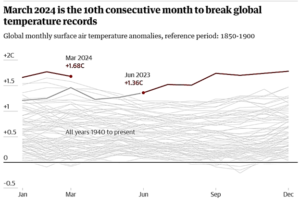
Tenth consecutive monthly heat record alarms climate scientists

Another month, another global heat record that has left climate scientists scratching their heads and hoping this is an El Niño-related hangover rather than a symptom of worse-than-expected planetary health.

Climate Temp Rising Mar 2024

Global surface temperatures in March were 0.1C higher than the previous record for the month, set in 2016, and 1.68C higher than the pre-industrial average, according to data released on Tuesday by the Copernicus Climate Change Service.  This is the 10th consecutive monthly record in a warming phase that has shattered all previous records. Over the past 12 months, average global temperatures have been 1.58C above pre-industrial levels.

Gavin Schmidt, the director of Nasa’s Goddard Institute for Space Studies, noted that temperature records are being broken each month by up to 0.2C. “It’s humbling, and a bit worrying, to admit that no year has confounded climate scientists’ predictive capabilities more than 2023 has.”

Diana Ürge-Vorsatz, one of the vice-chairs of the UN’s Intergovernmental Panel on Climate Change (IPCC), noted the planet has been warming at a pace of 0.3C per decade over the past 15 years, almost double the 0.18C per decade trend since the 1970s. “Is this within the range of climate variability or signal of accelerated warming? My concern it is too late if we just wait to see.”

The core problem – fossil fuel emissions – is well known and largely uncontested in the scientific community. A survey of nearly 90,000 climate-related studies shows a 99.9% consensus that humans are altering the climate by burning gas, oil, coal, trees, and trash.

Michael E Mann, the scientist whose 1999 “hockey-stick graph” showed the sharp rise in global temperatures since the industrial age, said the current trends were to be expected given the continuing rise in emissions. But he said that should not be a source of comfort. “The world is warming AS FAST as we predicted – and that’s bad enough,” he tweeted.

Oil Earth Out Of Balance

Earth Day is Everyday

For the Biden Administration, Earth Day is …Everyday

“This is a case where conscience and convenience cross paths, where dealing with this existential threat to the planet and increasing our economic growth and prosperity are one in the same. When I think of addressing climate change… I think of jobs.” 

President Joe Biden


Monday was Earth Day 2024, and on that day U.S. Senator Brian Schatz (D-Hawai‘i) announced that the Hawai‘i Green Infrastructure Authority will be receiving $62.45 million in Federal grant funding from the EPA which will fund solar power systems for many of Hawaii’s low-income households across the state.

“The new Solar for All grant funding will help low-income households across Hawai‘i take advantage of solar power and save money on energy bills – all the while cutting pollution and creating good-paying jobs statewide,” said Schatz.  The program is designed to provide financial assistance towards the funding of residential rooftop solar projects, as well as energy storage, and further enable the deployment of community-owned solar systems.  The solar grants being awarded are directed to projects expected to eliminate greenhouse gas emissions equivalent to 30 million metric tons of carbon dioxide and is projected to save U.S. households $350 million annually in reduced energy costs.

On the campaign trail, President Biden reminded voters that, “… Despite the overwhelming devastation in red and blue states, there are still those who deny the climate is in crisis.” “My MAGA Republican friends don’t seem to think it’s a crisis. They want to repeal the Inflation Reduction Act, which provides the funding for the vast majority of climate-related energy projects, and roll back protections for clean air and clean water.”

In addition, the Biden administration also announced the launch of a new website for the American Climate Corps (ACC), a national program aimed at training young people for clean energy and climate resilience jobs. The Nature Conservancy (Hawai‘i) and Kupu are among local organizations accepting ACC applications.


Tenth consecutive monthly heat record alarms and confounds climate scientists

This is the 10th consecutive monthly record in a warming phase that has shattered all previous records. Over the past 12 months, average global temperatures have been 1.58C above pre-industrial levels. And now exceeds the 1.5C benchmark set as a target in the Paris Climate Agreement but that landmark deal will not be considered breached unless this trend continues on a decadal scale.

Climate experts warn that if the heating anomaly does not stabilize by August, ‘…the world will be in uncharted territory in facing ever-rising temperatures’

10th Consecutuive Month Of Higher Gloabl Heating TempsAnother month, another global heat record that has left climate scientists scratching their heads and hoping this is an El Niño-related hangover rather than a symptom of worse-than-expected planetary health.

Diana Ürge-Vorsatz, one of the vice-chairs of the UN’s Intergovernmental Panel on Climate Change (IPCC), noted the planet has been warming at a pace of 0.3C per decade over the past 15 years, almost double the 0.18C per decade trend since the 1970s. “Is this within the range of climate variability or a signal of accelerated warming? My concern is it might be too late if we just wait to see.” 

Michael E Mann, the scientist whose 1999 “hockey-stick graph” showed the sharp rise in global temperatures since the industrial age, said the current trends were to be expected given the continuing rise in emissions. But he said that should not be a source of comfort. “The world is warming AS FAST as we predicted – and that’s bad enough,”

Gavin Schmidt, the director of NASA’s Goddard Institute for Space Studies, noted that temperature records are being broken each month by up to 0.2C. “It’s humbling, and a bit worrying, to admit that no year has confounded climate scientists’ predictive capabilities more than 2023 has.”

Based on preliminary analyses, Schmidt added:  “If the anomaly does not stabilize by August – a reasonable expectation based on previous El Niño events – then the world will be in uncharted territory. It could imply that a warming planet is already fundamentally altering how the climate system operates, much sooner than scientists had anticipated.”

The core of the problem – fossil fuel emissions – is well-known and largely uncontested in the scientific community. A survey of nearly 90,000 climate-related studies shows a 99.9% consensus that humans are altering the climate by burning gas, oil, coal, and trees (as in biofuels).

In 2023, global levels of the greenhouse gas rose to 419 parts per million, around 50 percent more than before the Industrial Revolution. That means there are roughly 50 percent more carbon dioxide molecules in the air than there were in 1750.  As carbon dioxide builds up in the atmosphere, it traps heat and warms the planet – period!

“Stopping further warming requires rapid reductions in greenhouse gas emissions,” said Samantha Burgess, the deputy director of the Copernicus Climate Change Service.


Living in Denial

Opposition to climate science comes from a variety of vested sources, but not too surprising is the fossil fuel industry – in particular the 57 companies linked to 80% of greenhouse emissions – and stands to lose trillions of dollars in the current global transition to a clean energy economy.

Just last month, Saudi Aramco chief executive Amin Nasser was applauded at an oil industry conference in Houston for declaring: “We should abandon the fantasy of phasing out oil and gas.”


Clean Vs Dirty Energy

Hawaiian Electric; Power Broker or Power Failure

Three Hawaii State Senators reached out to the state’s PUC this week requesting the agency investigate Hawaiian Electric’s recent rash of customer power failures on Hawaii Island and Oahu.  The Senate shout-out to the PUC comes followed by multiple service outages in the form of utility-initiated rolling blackouts.

The three state senators, Sen. Glenn Wakai, chair of the Senate Committee on Public Safety and Intergovernmental and Military Affairs; Sen. Jarrett Keohokalole, chair of the Senate Committee on Commerce and Consumer Protection; and Sen. Lynn DeCoite, chair of the Senate Committee on Energy, Economic Development and Tourism, altogether, reminded the Public Utilities Commission of its investigatory powers under state law while expressing their collective concern about recent utility-initiated service disruptions.  The letter then requested the Commission to conduct an appropriate investigation with the following noteworthy guidance:

“On Sunday night, some 13,000 O‘ahu utility customers were without power for several hours and some continue to be without power … At the same time 21,500 customers on Hawai‘i Island experienced an outage, and HECO [Hawaiian Electric Company] issued another alert to expect more,” the letter sent Tuesday reads.

“The PUC [Public Utilities Commission] has the statutory responsibility to regulate Hawaiian Electric proactively in the public interest and can use its investigatory powers … to ensure that electric utility services are delivered safely and reliably,” the letter continues. “The lack of reliability due to insufficient energy generation, HECO’s aging equipment, unreliable oil-fired power generation, and immediate and long-term solutions should be investigated.”

Missing from the Senate trio’s call to action was the Senate’s powerful chair of the Ways and Means Committee, Donovan Dela Cruz.

Dela Cruz, in his senate role over budget appropriations finance, has taken on the self-appointed role of deciding which bills (after extensive due legislative process) can proceed to the Senate floor for members decide the fate of such bills, in the form of a floor vote.  Notably, Dela Cruz’s public pronouncements and legislative track record often resemble that of the Utility’s lobbyist, supporting utility positions and priorities, contrary to the public interest and ratepayers.

It’s too easy to dismiss all this as politics as usual. Senator Dela Cruz’s intervention often carries with it consequences that further enable Hawaiian Electric’s history of slow-walking the state’s transformation to clean energy, greater service reliability, and lower ratepayer costs through clean energy alternatives available today.  The result of these political actions, a roadblock to essential clean energy reforms. Reforms which could potentially upset Utility investment interests designed to serve shareholder profits through continuance of the state’s present energy dependency on the Utility’s combustion energy suppliers, both utility-owned and third-party suppliers.

Utility Talk Points 

Senators Dela Cruz and Wakai have been reading from the Utility’s script, falsely extolling the virtue of so-called firm (combustion) energy, and with half-truth arguments which to explain away the recent rash of power failures, and shifting blaming onto weather conditions, not utility management decisions. Falsely blaming the power shortfalls on an absence of sun and wind, with the utility majority of generation fully dependent on last century combustion plants is misleading, to put it kindly.

In a host of the Utility’s narratives, some local media commentators just read the utility’s script provided to them. Just yesterday, HPR’s local reporting blamed the two island customer service outages on solar and wind generation, of the lack thereof.

Kapolei Sun Wind Energy Storage Plant Oahu

As Senator Tim Richards of Hawaii Island rather ineptly and incorrectly explained the problem this way, “There was no sun or wind” and that was the cause of the power shortage.

With all due respect to the Senator, the Sun shines every day. Even on cloudy or rainy days, solar energy is effective in generating electricity, but not at full capacity as on a bright cloudless day. Within any 24 hour period it is difficult not to find a moment when at least a mild breeze does not occur driving wind turbines.  The all-or-nothing solar and wind energy scenario being promoted by utility and its allies fails to take into account the utility’s primary dependency on grid-associated combustion power plants, frequently off-line for expensive maintenance cycles and / or unplanned service disruption events.

On Oahu, part of the utility-led excuse was directed at the Energy Plus Power plant, state-of-the-art solar, wind, and energy storage power facility. The Kapolei Energy Storage facility alone produces up to 565 MWh of on-demand power and on a 24×7 basis. The grid-connected solar, and wind generation power generation have been designed to replace Oahu’s former 180 MW AES coal-fired power plant, retired in September 2022.

Brandon Keefe, Plus Power’s executive chairman described the new battery storage plant this way …“It’s the first time a battery has been used by a major utility to balance the grid: providing fast frequency response, synthetic inertia, and black start. This project is a postcard from the future — batteries will soon be providing these firm-power services, at scale, on the mainland.”

Outage Autopsy

Assuming for a moment that Oahu’s solar and wind were generating at capacity the day before the Oahu outages, the Kapolei Energy Storage facility can store any utility excess grid power from other power sources within its capacity, with reasonable grid and load-balancing power management. This option assumes the utility and its suppliers operate within 21st-century guidelines and base their power management decisions on projected generation for any 24-hour period, including solar, wind, and hydro generation, along with connected energy storage assets.

Mainland utilities increasingly invested in renewable energy sources coordinate with their energy suppliers on a supply and demand power management basis. Their power management technologies are fully integrated into meteorological data, among other factors guiding supply and demand predictions.

Reliably predicting weather patterns three or more days in advance has been standard meteorological practice for decades. Perhaps the state’s largest Utility just failed its power management responsibilities to incorporate predictive weather modeling, fully aware of the present combustion power plant production shortfalls it has been struggling with all this month.

Combustion Plant Shortfalls

On Hawaii Island, Hawaiian Electric’s Hill 5 steam unit tripped offline on Saturday. The Utility’s Puna steam unit and CT-1 combustion turbine units are also under repair and non-operable. At the same time, its Keahole CT-5 unit only is expected to return to operational status after completion of its annual overhaul by the end of April. All these burn-fuels-for-energy power plant examples together generate about 62 megawatts. In addition, independent power producer Hāmākua Energy, Hawaii island’s largest generator, providing up to 60 megawatts to the grid, remains offline, while the Puna Geothermal power plant is operating at less than 2/3 power capacity of its PPA commitment to the utility.


For further details, we recommend viewing: https://www.beyondkona.com/hawaiian-electric-operating-in-hawaiis-best-interests/ 

Hawaiian Electric, Operating in Hawaii’s Best Interests?

Hawaii Island residents awoke to alarming news in February, and then again in March. Hawaiian Electric (aka HELCO) warned customers that the utility’s electricity services (which most County residents take for granted) would be facing rolling service blackouts and potential service disruptions of one or more hours in duration – and to be prepared for a loss in service…


Hot Ocean Sunset

Hawaii’s Ocean is Hot, and Getting Hotter

All in all, 2023 was Earth’s hottest year in over 150 years. Surrounded by Ocean, Hawaii’s climate clock is running down to zero hour faster than many realize.  As it was with ancient Hawaiians, Hawaii today is fully dependent upon and linked to the ocean which surrounds it.

Ocean Heatting Graph 2For the past year, oceans around the world have been substantially warmer than usual. January 2024 was the hottest month on record in the world’s oceans, and temperatures have continued to rise since then.

The New York Times described the new climate findings earlier this week in very stark terms with a headline that read;  “Scientists Are Freaking Out About Ocean Temperatures”.

For the past year, oceans around the world have been substantially warmer than usual. Last month was the hottest January on record in the world’s oceans, and temperatures have continued to rise since then. Each new year now is producing new global heating records.

New data from a variety of sources has led climate scientists to suggest that global warming is accelerating

University of Miami, Brian McNoldy, an expert in hurricane formation, has been tracking the latest temperature data from the North Atlantic with a mixture of concern and bewilderment. McNoldy sums things up this way …“The North Atlantic has been record-breaking warm for a year now,”, “it’s just astonishing. It’s quite scary, partly because I’m not hearing any scientists that have a convincing explanation of why it is we’ve got such a departure. We’re used to having a fairly good handle on things. But the impression at the moment is that global heating has gone further and faster than we expected.”

Over the past year, worldwide average temperatures were more than 1.5 degrees Celsius, or 2.7 degrees Fahrenheit, higher than before the industrial age, and sea temperatures have kept on climbing in February, surpassing the daily records set last August.

The principal driver of all this warmth is no mystery to scientists: The burning of fossil fuels, global deforestation, and other human activities are driving temperatures steadily upward. The current El Niño weather cycle is also allowing more ocean heat to be released into the atmosphere.Ocean Heat Hurricane Supercharging

More than 680 million people, nearly 10 percent of the global population, live in low-lying coastal zones. Bearing the brunt of climate-driven ocean extremes, some highly vulnerable communities in low-lying areas, including small Pacific island chains, are 15 times more likely to be killed by floods and storms, compared to other regions with lower climate vulnerability.

A well-established link between rising ocean temperatures and an increasing imbalance between healthy marine environments is also well understood.

The ocean further generates 50 percent of the oxygen we need, absorbs 25 percent of all carbon dioxide emissions, and captures 90 percent of the excess heat generated by these emissions. It is not just ‘the lungs of the planet’ but also its largest ‘carbon sink’ – a vital buffer against the impacts of climate change.

The ocean is also central to reducing global greenhouse gas emissions and stabilizing the Earth’s climate.  However, increasing greenhouse gas emissions have affected the health of the ocean  – warming and acidifying seawater – causing detrimental changes to life underwater and on land, and reducing the ocean’s ability to absorb carbon dioxide and safeguard life on the planet.

Warmer oceans provide more fuel for hurricanes and atmospheric river storms and can disrupt marine life, and life on land. Hawaii’s policymakers and residents who ignore what’s happening around them and delay or procrastinate meaningful transition measures which prepare Hawaii for the new climate reality now underway, do so at their and everyone else’s peril.


The Climate Outlook for Hawaii and the Mid-Pacific

New data from a variety of sources has led some climate scientists to suggest that global warming is acceleratingIt was the hottest January on record for the oceans, too, according to the European Union’s Copernicus Climate Change Service.

Ocean Heating Sat View

The intensity of recent underwater heat waves prompted the National Oceanic and Atmospheric Administration in December to add three new levels to its system of ocean heat alerts to indicate where corals might be bleaching or dying.

It is already well established that Hawaii’s globally remote mid-Pacific location does not exempt the state from macro changes in climate, rising temperatures, and extreme weather events no underway. Changes in climate are further impacting Hawaii’s historic seasonal weather and temperature patterns, producing increasing extreme weather events, as the painful consequences of the recent Lahaina extreme wind storm and fire tragedy demonstrated to all of Hawaii’s residents.

For island states like Hawaii, sea level rise is inescapable.  The global impacts of warming are compounded by El Niño events in the equatorial Pacific, increasingly fueling elevated sea surface temperatures and the corresponding consequences.

Ocean temperatures in the mid-Pacific have been rising steadily and significantly over the past 50 years, consistently rising, with an average rise of 0.14°F per decade from 1901 through 2020.  Recent data shows that overall ocean temperatures have surpassed 70° Fahrenheit, reaching uncharted territory for modern records.

The rapid acceleration of ocean temperatures has now led scientists to express serious concerns about the uncharted territory we are entering due to unprecedented levels of warming in oceans and air temperatures.

For Hawaii, rising ocean temperatures are already having profound impacts on:

  • Marine ecosystems
  • accelerated coral bleaching,
  • changes in biodiversity, and
  • disruptions to weather patterns, locally and globally, and 
  • agricultural impacts.

An El Niño pattern like the one currently observed in the Pacific is associated with warmer years for the planet, as well as a swath of effects on rainfall and temperatures in specific regions.

Island Sea Shoreside Water RiseBut as humans heat the planet, the effects that forecasters could once confidently expect El Niño to have on local temperatures are no longer predictable, said Michelle L’Heureux, a NOAA scientist who studies El Niño and its opposite phase, La Niña.

As rising temperatures drive rising sea levels, Hawaii and other island states find themselves on the front lines of changes now demanding a sea-change of climate adaptation measures in the form of local mitigation measures; environmental, structural, and social.

The Effects of Sea Level Rise in Hawaii

Sea level rise in Hawaii is primarily attributed to global warming and the resulting melting of ice caps, leading to the expansion of seawater and the inundation of coastal areas. The rise in sea level around Hawaii is accelerated by factors such as melting ice caps, increasing air and sea surface temperatures, an overall decline in rainfall, and decreased stream base flows.

The impacts of rising sea levels in Hawaii are already being felt and are projected to worsen significantly in the coming years, Hawaii can expect:

  • Coastal Flooding: Increased frequency and reach of coastal floods affecting communities.
  • Coastal Erosion: Loss of beaches with 13 miles already eroded, threatening 70% of beaches statewide.
  • Inland Flooding: More frequent flooding further inland, affecting communities not just near the coast.
  • High Tide Flooding: More frequent high tide flooding threatening cities, damaging infrastructure, roads, and overwhelming drainage systems.
  • Cultural Impact: Affecting traditional practices like fishpond maintenance, salt cultivation, and nearshore fisheries gathering.

Sea Level Rise HonoluluA 2050 forecast of rising sea levels, increasing droughts, and hot ocean temperatures in the waters surrounding Hawaii all point to a state presently unprepared for the growing threat to the state’s sustainability, economic viability, and livability.

In the last decade, the speed at which Hawaii’s sea level is rising has increased — rising by as much as 1 inch every 3 years. Around Hilo Bay, it took 17 years for the sea level to rise 6 inches. Scientists now forecast the same increase in sea level rise will occur in less than the next 12 years.

By the end of the century, Honolulu could experience a sea level rise between 1.3 feet and 5.8 feet, and depending rising and accumulated carbon emissions.  Events may be moving faster than science as forward looking sea-level estimates are increasingly being challenged as “too conservative”.  Only recently has science begun to fully understand and factor new data elements such as recently quantifiable and accelerating meltdown of antarctic glaciers and ice caps.  It is increasingly likely that Hawaii overall will see 3 feet or more of sea level rise by the end of this century, with higher levels plausible.

Building resilience into Hawaii’s economic, social, and environmental ecosystems requires more than just focusing on the state’s coastal communities.  Hawaii is dependent upon a healthy and predictable ocean. That would include adaptation measures that predict risks, vulnerabilities, and solutions – including early warning systems and sustainable nature-based solutions to help communities cope with changing coastlines and failing ecosystems now under climate stress.


Publisher’s note to our readers

Continuing to live in the past is a social, economic, and cultural failure of state policy towards a meaningful climate threat response. This failure can be measured in varying degrees, but the indisputable conclusion is we are failing ourselves, our families, and placing added risks on the current and future generations of Hawaii’s residents – it is our carpe diem climate moment. 

Solar Person Graphic

Hawaii’s Clean Energy Options; Today

Chapter One – what happened …

Recently, residents and businesses of Oahu and Hawaii Island were advised of an all too familiar public message “…customers are asked to reduce electricity use.

Just last week local news outlets led with this story and requested of Hawaii Island residents…“Hawaiian Electric is asking residential and business customers on Hawai‘i Island to reduce their electricity use tonight, especially from 5 p.m. to 9 p.m. when electricity use is highest. The conservation of power will help ensure that there is enough power available for all customers.”

Power OutageThe Utility’s request for energy conservation was prompted by the failure of more than one of its large (so-called firm energy) combustion power plants. Two other combustion power plants were also shut for maintenance demonstrating the fragile of house of cards of the state’s energy grid. It was also what became the perfect storm in a chain of gird operating events concluding in a power supply emergency, and forcing the utility into a series of rolling customer power blackouts in an effort to prevent a system-wide power failure.

Hawaii Island’s 17,000 rooftop solar residents and businesses, and utility customers with whole house battery back-up were unaffected and remained power self-sufficient during the declared power emergency. These same utility customers were also fully protected from the utility’s planned rolling power outages, which also come with notorious property-damaging power surges impacting appliances, computers, and other plugged-in high-value electronics.

HELCO’s power problems began when independent power producer Hamakua Energy (a hybrid fueled combustion power plant consisting of 90% tar sands oil and 10% bio-fuel mix) unexpectedly tripped offline late in the afternoon.

Powerwall Gateway Report Outage SmallHELCO’s remaining combustion power plants on which the utility relies, were either shut for repeated maintenance and repair cycles.  In the case of the state’s only geothermal power plant, Puna Geothermal Venture on Hawaii Island, the plant has been operating at reduced power production capacity, and well below its power production commitment to HELCO, and in its reduced operating state unable to close the power gap.  This has been a recurring theme for PGV operations since the 2018 eruption of Kilauea which fully disrupted geothermal operations for more than 2 years. It further demonstrates in this most recent power failure event PGV’s inability to perform as contracted, and supports what local critics of the plant have been saying all along … it is a community environmental hazard, expensive to operate, and unreliable in its capacity as a so-called firm power plant.

In addition to Hamakua service disruption and PGV’s power capacity issues, Hawaiian Electric’s Hill Plant Unit No. 5, Keahole CT-5, and separately, Puna Steam Plant were shut down and unavailable for scheduled maintenance and repairs (high maintenance for combustion power plants with their many system components and moving parts is indicative of the technology required to maintain 24×7 firm power combustion plant operations).

The only grid-scale solar power plant plus storage on Hawaii Island, the AES Waikoloa Solar + Storage Plant which began commercial operations in April 2023, mitigated the impacts of utility’s overall system operating failures and production shortfalls. The Solar plant is the largest project of its kind on Hawaii Island, with a 30 MW solar photovoltaic system and a 120 MWh containerized lithium-ion battery energy storage system. Just this one Solar plant addition to the grid is expected to lower residential monthly utility bills by about $5.

The project is located on 300 acres along Waikoloa Road and is supported by a 25-year Power Purchase Agreement (PPA) with Hawaiian Electric, providing power to nearly 14,000 homes. The plant is designed to reduce visual impacts, has undergone cultural and archaeological assessments, and includes safety measures such as fire suppression systems and non-vegetated firebreaks. The project has been well received by the community and is a shining example of how Hawaii can achieve it’s 100% (clean) renewable energy goal before 2045.

Aes Waikoloa SolarAltogether, the solar plant propped-up the utility’s combustion plant-generated power shortfalls and a system wide service outage.  Solar energy+storage  at utility scale, coupled to customer sited distributed rooftop solar assets prevented a bad power situation from getting much worse.  Extra credit was due island residents who curtailed their power consumption during the grid operating shortfall.  Hawaiian Electric and ratepayers were lucky in contrast to what could have easily been a much worse and extended loss of service across the entire Island, and a greater service outage impact on residents and the economy.


Chapter Two – it all adds up

Fuel / Maintenance Costs, Operating Reliability, and Sustainability 

The U.S. Energy Information Administration which provides data on the operations and maintenance (O&M) costs for different types of power generation found that large-scale solar photovoltaic (PV) installations with/without battery storage are among the cheapest and most reliable power generation technologies to operate. According to the energy agency, a comparison of costs between solar power and combustion fossil and biofuels plants favors solar power installations, which have repeatedly demonstrated lower operating costs and minimal operating and maintenance (O&M) requirements, altogether supporting greater cost efficiency outcomes to the benefit of utility profits and ratepayer energy costs…

Beyond, periodic cleaning and inspection, solar energy power plants are truly the O&M low-cost energy winner.  In contrast, combustion power plants burn various fuels to create heat towards converting water into steam, which in turn spins large turbines to generate electricity — altogether is an electricity generation process that inherently results in higher operating costs and added fuel costs measured in combustion plant maintenance and operating costs.  Solar, and even Wind Power turbines, are simply cheaper to operate and offer greater power generation reliability when executed properly over the lifetime of their investment – a missing element of ratepayer consideration in Hawaiian Electric’s weak adoption record to date of solar and wind assets and clean power into their grid energy mix.

Hamakua Energy PlantIn a comparison of costs between solar and wind power vs. combustion power plants, solar and wind power installations can further credit their overall lower lifetime operating costs to their base fuels; sunlight and wind. These two natural energy zero-cost and zero-emissions fuel sources, although variable, do not have supply chain issues. In contrast, fossil fuel and biofuel power plants which not only have higher maintenance costs, are subject to the variables of continuous purchases of fuel-to-burn from suppliers, which are further subject to market supply variables and price fluctuations that contribute to higher energy costs borne by ratepayers, not utilities.

Added fuel costs and supply risks are associated with HE’s dirty energy combustion power plants, favored by the utility.   From a utility’s perspective, maintenance cost comparisons between combustion power plants and solar power plants are secondary financial considerations when costs and risks are fully assumed by ratepayers. Yet, both are important considerations in the choice of appropriate energy supply options available today.

Utilities often fail to fully factor all aspects of the energy source choices they make. Front and center is the plant’s return-on-investment (ROI) when utility the plant is utility owned and operated. Operating reliability considerations are generally relegated to a grid operators’ preference, in the case Hawaiian Electric, with issues as to the plant’s technology and operator (when third-party owned and operated), as secondary considers that rarely serve the public interest.   Altogether, important grid energy supply decisions represent the vested interests of the utility’s customer base ( ratepayers), but are rarely challenge assumptions by the public who generally trust the utility operate in their best interest.  Yet, within this one-sided relationship between utility and ratepayer, lessons repeatedly learned, are quickly and forgotten.  A call for significant changes in the present process of governing energy choices made by the regulated utility fail public scrutiny, gnerally after the fact, as recent events service outages on both Hawaii Island and Oahu have demonstrated.


Fully automated Solar plus Power Plant (Kauai)

Clean energy with power battery power provisioning at scale; no moving parts, low cost, high reliability of operation

Mililani Solar Power Plant


Combustion Power Plant example (Hawaii Island)

Maintenance-intensive, fuel burning reliant, less reliable, costly to operate, and polluting 

Hawaiian Electric Aging And Polluting Combustion Power Plants Hill Plant Unit No. 5 Google Search


Chapter Three – a power play

How the Power Playing Field is Changing

Hawaii’s utility lexicon is ripe with insider terms system like “baseload” and “firm power”. The latter is frequently used the Utility’s political agents as a weapon against solar and other under-deployed clean power options within the state (except in Kauai) to justify the status quo energy path we’re on and explain Hawaiian Electric’s (HE) power plant choices 9 times out of ten favoring combustion power plants. It is a future energy outlook in which state could burn its way off fossil fuels an onto other dirty fuel options associated with the state’s HE-dependent combustion power plants, both utility-owned and outsourced.

Most of Hawaii’s residents and state economy depend on HE’s combustion power choices and are expected to assume their electricity options are dictated by their utility and operate in their best interest. It is worth remembering that publicly-traded utilities, as is the case with HE are first and foremost responsible to their shareholders, and ratepayers (customers) are merely funding their operating profits.

However, ratepayers, which includes most state politicians, along with the state PUC do have options in directing the utility’s energy choices. Today’s combustion power plants are neither sustainable nor cost and energy-effective power options, they are merely easier low-risk, and utility-invested power options that come at a high cost to ratepayers who foot the bill, and to Hawaii’s residents who pay the price in pollution and unsustainable energy combustion outcomes at a time when our planet is undergoing a growing climate crisis.

Hawaiian Electric’s Baseload Utility Grid Power Model: Outdated, Costly, Less Reliable, and …Unsustainable

The 20th-century “Baseload” utility power model is increasingly costly, inefficient, and certainly out-of-step with 21st-century power demands and clean power technology replacements. Coupled with advances within the areas of energy storage, rooftop solar and utility-scale solar and wind resources coupled with battery storage technology are increasingly supporting grid scale 24×7 customer energy demands, with or without expensive last-century combustion power plants.

In the case of the state’s largest utility, Hawaiian Electric, it has been and remains stuck on a power provisioning strategy dominated by last-century utility operating assumptions, and primarily supported by combustion power plants burning various fuels around the clock to maintain a stable state of power output to the grid, aka baseload power.  It is also possible the most expensive power generation and operating practice within the state – one that is indifferent to customer self-generation energy opportunities and an overall market transition to a more distributed and resilient grid power provisioning architecture, one that further and further away from centralized 20th century grid power model, long-hauling power over great distances between the point of power generation, and the end point of consumption. It is a utility operating model that is increasing expensive to maintain, and increasingly unstable to operate in light of accelerating climate consequences worldwide.

Combined Base Distributed 24 Hr Power Generation Commparison

Today’s electricity grid system is highly reliant on so-called “baseload” power plants.  The combustion energy resources they represent are increasingly out of step with today’s lower cost, clean renewable energy technology options, and distributed energy options which enable power to be generated at or near the power of consumption instead of long-hauling power of a fragile and expensive grid system. In terms of operating reliability, Hawaiian Electric’s baseload energy supply models and partners are increasingly demonstrating more, not less, cost increases and unreliability in a changing world — and who pays the bills; utility ratepayers.

The price competition from zero emissions clean and 100% renewable energy combined with 21st-century energy storage options and natural gas is far stronger than it was in the past, meaning that it no longer makes sense to default to inflexible baseload power plants, which are enabled adjust and load-balance instantly ramp up and down, to serve variations in power demand. Instead, as many already are doing, regulatory and other decision-makers should focus on a framework that:

(a) effectively and efficiently defines a electricity system linked public needs and in compliance with clean energy policies designed to advance operational flexibility, resilience, greenhouse gas abatement, and last but certainly not least, lowering energy costs for consumers ), and secondly,

(b) develop tools, markets, and methodologies that draw upon an increasing range of available distributed zero emissions energy generation and storage options applied towards Hawaii’s unique service geography, as in self-reliant and stand-alone community microgrids linked together to rooftop solar systems and other localized clean energy power systems — it is complete transition to distributed statewide power system no longer dependent on a last century grid energy assumption and obsolete power generation and energy management assumptions presently governing the state’s largest utility.


Chapter Four – full of better options

Clean Power Community Microgrids; Resilient and Self-Sufficient

Community MicrogridGranted, there may never come a day when every qualified building rooftop in Hawaii will have solar installed and on-site batteries providing energy management security and efficiencies without the need for a centralized power monopoly.  However, Hawaii’s abundant natural and non-polluting solar and wind energy sources (when appropriately applied) are by far proven to be the most cost and energy efficient options available today.

Clean energy technology options which are available today with unprecedented consumer power visibility, flexibility, and management options. At the utility demand scale, battery storage offers on-demand power provisioning from wind sources (when the wind is not blowing) and solar energy at night with the ability to ramp up or down quickly to meet changing demands – eliminating the so-called need for grid-based and wasteful Baseload power production.

Community Microgrids further enable power resiliency by generating power at and near where power is consumed, rather wastefully long hauling to the point of consumption some distance away from where it is generated.  Microgrids manage and distribute power locally, offering greater power efficiency, providing power flexibility not otherwise possible, improve cost performance and power resiliency for all concerned.

Additionally, markets (including Hawaii) can and will eventually embrace the value of state-mandated energy policy options which advance today’s wind and solar power deployment options coupled to battery storage (scaled to firm power standards) — something HE has yet to demonstrate throughout its service territory, and certainly so not at scale to meet the state’s growing power transition requirements  off fossil fuels and to greater power self-sufficiency throughout the state. Between policy, will, and profit motivates out of synch with the greater good, Hawaii Electric  continues to stand in stark contrast Kauai Island’s clean energy leadership and business model.


editor P.S.

The Civil Beat reported earlier today (2-20-24) of a legislature-driven statewide taxpayer & ratepayer funded bailout of Hawaii Electric Co, ow in the works. CB reported that Lawmakers are calling for significant changes at Hawaiian Electric Co. in exchange for letting the utility charge a new fee to customers to raise money to deal with wildfire costs. The fundamental change sought by HECO would allow the company to impose new fees on its 460,000 customers statewide outside the standard ratemaking process. The utility could use the fees to finance bonds at a lower interest rate than it could otherwise obtain. 

HECO faces substantial liabilities related to the Maui wildfires, which destroyed much of Lahaina and killed at least 101 people last August. As a result, shares of parent company Hawaiian Electric Industries have plummeted, and credit rating agencies have downgraded the company’s to a junk bond rating, which in turn costs the utility more to borrow as it seeks to deal with rising wildfire costs and its fire-related operating liabilities. 

Sen. Jarrett Keohokalole, the legislative driver of a utility bailout said in an interview today. “Put simply, what’s being proposed is a fundamental change to the dynamic between the state and the utility. And so the question is…, What type of fundamental change should be made in return?”   

Our advice Sen Keoohaloke, read this article!