
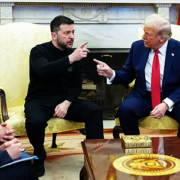
The First 100 Days; a self-righteous mission
update; originally published April 30th
The first 100 days of Donald Trump’s second presidential term has been marked by a poorly executed agenda with rising social, economic, and political costs. It has also been exemplified by Executive Branch overreach, poor execution, false justification, and confusion, and last but not least, delusions of monarchy coupled with fundamental ineptitude.
The result is general public anxiety, markets falling precipitously along with many Americans’ shrinking retirement savings, and global uncertainty, each impact marked by unshakable American confidence that has been shaken, not stirred.
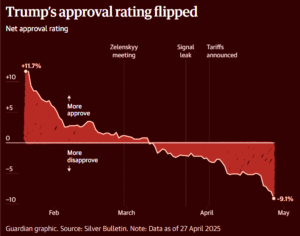
After a hundred days in which Trump at times appeared invincible, political gravity is exerting itself. A majority of Americans regard him as both a failure and a would-be dictator. From the courts to the streets, from law offices to college campuses, revolt is swelling. Republicans are eyeing next year’s midterm elections with nervousness.
“The honeymoon is over,” said John Zogby, an author and pollster. “He actually squandered his hundred days, perhaps you can argue, by doing too much, not succeeding with much of it and overplaying his hand. At the end of the 100 days his polling numbers reflect an unsuccessful quarter. Every poll that I know of, including mine, has him upside down.”
If rising economic uncertainties and growing public anxiety weren’t enough, then there the legal issues accompanying Trump’s new presidency, marked by non-stop executive overreach in this now first hundred days of this presidency. Notably, unqualified leadership shake-ups of key Federal agencies have been rubber-stamped by a Republican majority, in what is at the moment a one-party system without pubic accountability.
On day one the Trump presidency kicked-off a flood of presidential pardons of January 6th insurrectionists previously jailed for their Congressional attack and other criminal acts against the American people.
According to a poll published by the Washington Post newspaper and ABC News, only 39% of Americans approve of how Trump is conducting his presidency. About 64% of respondents said he was “going too far” in his efforts to expand presidential powers.
Governing by Executive Order
As of this past Monday, Trump signed more than 140 executive orders, far more than any American president in the same period. He is also rapidly approaching the number that former president Barack Obama signed during his entire first term in office.
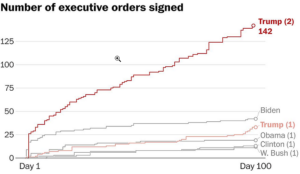 Trump’s record-breaking use of executive powers is too often thinly and repeatedly justified by the president and his supporters as following a so-called “voter mandate” which elevated Trump to the office of the presidency without guardrails or accountability. In reality, Trump’s win was marked by the slimmest of margins (one and a half percent).
Few Americans signed up for a new President with unprecedented authoritarian powers – powers directed towards knocking down the pillars American democracy, representative governance, and public accountability — in so doing reducing America’s system of representative government to one man.
The 2024 election results favoring Trump produced a winner with less than 50% of the vote, and less than a 1.6% percent winning margin of the popular vote — anything, but a national mandate to violate laws, and foreshake common good in name of false efficiency and unqualified corruption allegations across the Federal Government, all from the chaos playbook of Project 2025. Trump’s presidential actions are far from representing the public interest, and so-far have demonstrated they are in fact coming at the expense of the Republic and the American people.
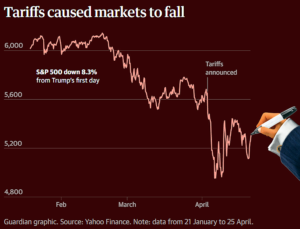
The US economy contracted 0.3% in the first quarter, due to a monumental pre-tariffs import surge and declining consumer spending.
President Trump spent much of his first quarter threatening, then implementing sweeping tariffs on Canada and Mexico, and targeting China with higher duties on record for its exports to America.
As it stands, today, President Trump, by fiat, established a 10% universal tariff on all imported goods to the United States from much of the world, along with a particularly egregious 145% tariff on all imports from China. Trump’s tariff policy, Congressional oversight or approval, is beginning to impact the pocketbooks of most Americans. U.S. businesses in the coming months, as pre-tariff supplies run out will be forced to further pass on costs into the economy.
Trump’s shoot from the hip global tariff policy economists forecast is risking America with both recession and inflation simultaneously, also know as stagflation. Trump tariffs are also setting America on course of repeating history with economic repercussions similar to the 1930 enacted Smoot-Hawley Tariff Act which triggered retaliatory tariffs and leading to a sharp decline in global trade and exacerbating the Great Depression.
The first quarter 2025 drop in nation’s economy comes amid a huge fall in consumer sentiment, which in April dropped 32% to lowest level since 1990 recession.
On the Climate front, Trump falsely declared in his first days in office that America is in an “energy emergency”. He used this false-narrative as justification initiate a national policy reversing America’s emerging clean energy economy, climate initiatives and environmental regulations governing various forms of fossil fuel pollution and climate emissions.
The Trump administration has also systematically dismantled and otherwise abandoned America’s scientific leadership in addressing Climate Change threats to social, economic, and environmental stakeholders now addressing growing global heating impacts.
On the Clean Energy front, the Trump administration has been trying to claw back money allocated to states for electric vehicle charging, home energy retrofits, electric school buses, utility bill assistance, and more. Even longstanding tax credits that states rely on to transition to clean and renewable energy have been targeted for elimination. On top of all this, the president has threatened to sic his attorney general on states with ambitious climate policies, including Hawaii.
For additional information; reference BeyondKona story published April 10th: https://www.beyondkona.com/trump-led-policies-crashing-the-us-hawaii-economy/
State lawmakers around the country are also re-negotiating their budgets for the coming year amid unprecedented Federal uncertainty. Any decisions they make now about how to spend state and Federal funds may need to be revisited after Congress finishes its budget reconciliation bill, which will mostly likely further hollow-out key Federal programs state economies depend on and Federal programs state governments upon; including Hawaii.
See published February 8th in BeyondKona; https://www.beyondkona.com/the-new-reality/
“The weakness this quarter is also a preview of weakness in future quarters,” said Tara Sinclair, director of the Center for Economic Research at George Washington University. “We are seeing a dramatic change in people’s behavior, similar to what we saw during the shock of the pandemic. They’re front-loading purchases they might’ve made earlier in the year, and that’s very concerning for future quarters.”


 Consumers were more pessimistic about current and future labor-market conditions as well as the outlook for incomes and business conditions. Perceptions of present and future financial situations worsened and the
  Key Impacts on Hawaii’s Economy


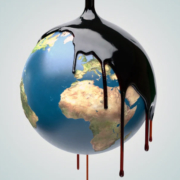
 Fossil fuel interests successfully purchased the grand prize, the presidency and at bargain rates in terms of influencing an about face in national energy policy from a developing national clean energy economy, and full reverse backwards to 20th century fossil fuel dependent economy, but with a 21st century climate impact price tag. The US oil and gas industrial sector stands to heavily profit from the new Trump administration’s national Trump-directed energy mantra, “drill baby drill”.

 Trump’s message to the Country earlier today went to the core of his political appeal: convincing his supporters that he — and he alone — can fix what ails (or does not ail) the country. And it represented a reprise of how he framed his first presidency — as a constant fight against enemies, foreign and domestic.
 On a happier note, in the Senate, Mazie Hirono, Hawaii’s incumbent Democrat, won re-election with 64% of the vote, defeating Republican Bob McDermott. Hawaii’s other Federal races produced expected Democratic victories, e.g., in the 1st Congressional District, incumbent Democrat Ed Case will return for another term, and in the 2nd Congressional District, Democrat Jill Tokuda secured 63% of votes, ensuring her return for another term. This outcome was consistent with Hawaii’s historical tendency to support Democratic candidates in presidential elections.


 The filing from special counsel Jack Smith’s team offers the most comprehensive view to date of what prosecutors intend to prove if the case

 President Biden’s signature climate and energy law, the 2022 Inflation Reduction Act (IRA), is fueling the growth of a unprecedented national clean energy transition. One which has been enabling the adoption of zero emissions and renewable wind and solar energy sources, battery storage, and other clean technologies reducing local and global emissions along with consumer energy costs.