

My Mind is Made Up, Don’t Confuse Me with Facts
If there is a way to best describe President Trump’s one-made administration and view of the world as to what is right and wrong, it’s a mission increasingly guided by a self-appointed presidential mission flowing with aggrandize public statements best summed up as “misinformation” and guided a by single ethos; …“My Mind is Made Up, Don’t Confuse Me with Facts”.
The status of US government and taxpayer-funded scientific assets shut down in 2025 at the start of second Trump presidency has been in a word; reckless. Altogether, these Trump-targeted public research and scientific reporting assets are (and were) responsible for monitoring, reporting, and providing their public findings and analysis on national and global climate-related developments, are today either shut down or on life-support, unable to fulfill their nation mission to alert and inform the public and lawmakers as to climate threats and human-impacts to the public, the nation, and the world.
Shutdown of Key Climate Monitoring & Analysis Assets
- NOAA Billion-Dollar Disaster Database: Discontinued in May 2025, this database tracked the costliest U.S. weather and climate-related disasters.Climate.gov: The primary NOAA website for public-facing climate science, tracking, and data had its staff of 10 terminated on May 31, 2025, effectively shutting it down.
- US Global Change Research Program Website: The site hosting comprehensive, mandated federal climate reports was taken down.
- NASA Climate Missions: The administration proposed eliminating funding for Orbiting Carbon Observatories (OCO-2 and OCO-3), which measure carbon dioxide emissions.
- Environmental Justice Mapping (EJScreen): Removed from the EPA website on Feb 5, 2025, along with related environmental justice and equity information.
- National Center for Atmospheric Research (NCAR): In December 2025, the administration announced plans to “break up” or dismantle this major federal climate research center.
- Ocean Sensors: A targeted 80% funding cut to the Ocean Observatories Initiative, which monitors marine conditions.
- Mauna Loa Observatory Support: Plans were reported to end leases on NOAA facilities, including the Global Monitoring Laboratory in Hilo, Hawaii, which tracks atmospheric CO2.
Status Reporting and Assessment Shutdowns
- National Climate Assessment (NCA): The administration halted work on the 6th NCA, fired 400+ scientists working on it in April 2025, and removed previous assessments from federal websites in June 2025.
- EPA Greenhouse Gas Reporting Program: The agency initiated moves to terminate the program that requires industrial facilities to report emissions.
- EPA Climate Adaptation Resources (ARC-X): Removed, including “Implications of Climate Change” and “Climate Resilience Evaluation and Adaptation Tool” (CREAT).
Research and Funding Terminations
- NSF Climate Grants: More than 100 National Science Foundation grants for climate research were terminated in June 2025.
- Clean Energy Funding: In October 2025, the Department of Energy halted over $7.5 billion in funding for 223 clean energy projects.
- International Climate Reporting: The administration stopped involvement in the Intergovernmental Panel on Climate Change (IPCC) and ordered federal scientists to stop work related to it.
The World’s Ocean has been hoarding Heat, building up a massive release
The ocean affects global weather, provides vital food source for much of the planet inhabitants, and humans a link to Earth’s greatest asset. The ocean’s system of temperature management (it’s thermostat) has been hoarding heat for time now, and ever increasing rates as humans load the plant with every increasing amount of CO2 emissions. Scientists study ocean temperatures recently determined, our oceanic systems are now building up to a massive CO2 ‘burp.’
When, and if, we humans manage to cut enough emissions and eventually reduce global temperatures, new research shows the Southern Ocean could supercharge global warming (heating).
The expansive Southern Ocean wraps around Antarctica.
Since the Industrial Revolution kicked off, humans have dialed up the world’s temperature to the max, adding extraordinary amounts of heat into the atmosphere, and more than 90 percent of which has been absorbed by the world’s oceans, along with a quarter of our CO2 emissions.) Under climate change, the Southern Ocean has been storing heat which, like a morning jolt of expresso, that heat can’t stay there forever, and will someday return to the atmosphere.
The Southern Ocean may encircle the frozen continent of Antarctica, but it’s very effective at storing heat: It alone holds around 80 percent of the warmth that’s taken up by all the oceans. Some of this comes from currents that transport relatively toasty waters south, but also lots of upwelling in the Southern Ocean brings cold water to the surface to be warmed up.
The skies above the Southern Ocean are also somewhat less reflective than elsewhere around the globe. Cargo ships and industries in the Northern Hemisphere spew air pollution in the form of aerosols, which themselves bounce solar energy back into the cosmos and help brighten clouds, which reflect still more. That cooling phenomenon has vied, in a sense, with the warming that’s come from the burning of fossil fuels. “That competition hasn’t been as prevalent over the Southern Hemisphere, because it’s this slightly more pristine atmosphere.
In the scenario the researchers modeled, the atmospheric concentration of CO2 increases by 1 percent every year until the total amount is double what the planet had before the Industrial Revolution. Then negative emissions technologies reduce the carbon concentration by 0.1 percent annually.
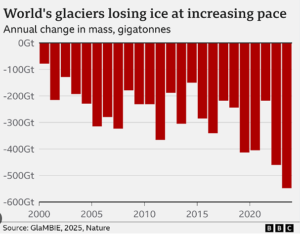
Massive glaciers are melting rapidly worldwide due to rising global temperatures from human-caused greenhouse gas emissions,
The Antarctica’s Thwaites Glacier (“Doomsday Glacier”) and Greenland being major concerns due to their vast ice volume and potential to significantly raise sea levels, are “now” melting at unprecedented rates, since humans walked the Planet.
This glacier-meltdown contributes to sea-level rise. The Thwaites Glacier is now melting at an unprecedented rate and will bring to the world’s coastlines (Hawaii included) an ocean level rise estimated between 3 – 12 feet, with unprecedented consequences. Beyond massive increases in coastal erosion, beach-front property destruction, beach losses, the melt-down is now fueling intense storms, which in turn are threatening coastal cities and ecosystems globally. But this global meltdown, which only now gaining public attention, is not isolated to the southern ocean. Glaciers around the world are now experiencing some degree of meltdown, and are at risk of vanishing soon.
Scientists are racing to understand these accelerating global heating by-products of a fossil-fueled global economy. And the melting down processes now underway, especially the destabilizing effects on West Antarctica, which could lead to catastrophic sea level rise if glaciers like Thwaites collapse.


Leave a Reply
Join the Community discussion now - your email address will not be published, remains secure and confidential. Mahalo.